Will There Be Foreign Intervention?
Will There Be Foreign Intervention?
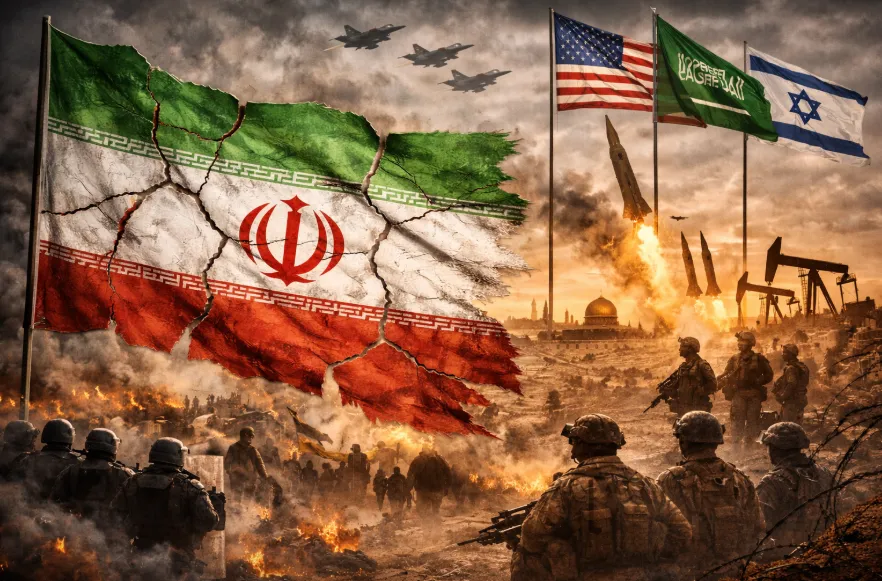
This is a question heard repeatedly these days, both inside and outside Iran. While difficult to answer definitively, it can be approached through observable evidence, including military movements and past and present statements by officials. This leads to a broader question: has the lifespan of the Islamic Republic reached its end for the West and for regional states? Has removing the regime become more useful, or more feasible, than before?
Any serious analysis requires realism, a long-term perspective, and restraint from emotional conclusions. At best, analysts can offer assessments with varying degrees of probability, not certainty. One such line of analysis suggests the following.
The mass killings carried out by the Islamic Republic over the past three weeks, including the massacre of protesters on January 8 and 9, the killing of wounded protesters in hospitals, and the rushed executions of detainees, do not on their own justify foreign military intervention. However, they do constitute a powerful international justification. These actions reflect a regime that fears the loss of its legitimacy in the eyes of both its own people and the international community. Regimes that reach this stage often resort to mass violence to signal that they still hold power. What they ultimately demonstrate, however, is that their power is limited to repressing unarmed civilians, a reality that foreign governments clearly recognize.
The twelve-day war revealed the true balance of power between the Islamic Republic and foreign states. In many ways, that conflict was shaped by mounting evidence of the regime’s weaknesses accumulated over decades, and particularly during the 2023–2025 period, when the regime’s rhetoric, especially its threats, increasingly proved hollow.
The United States and its allies, particularly in the Middle East, have spent decades pursuing different approaches, for different reasons, but with a shared objective: steering the Islamic Republic toward what they considered normal state behavior. This objective was visible even in the Obama administration’s approach, which is now deeply unpopular among many Iranians, as well as in the policies of both Trump and Biden.
Although the Obama administration invested heavily in reaching a nuclear agreement and appeared primarily focused on nuclear containment, the preface of the JCPOA, despite the Islamic Republic’s insistence on narrowing its scope, stated that all signatories expected its implementation to contribute to regional and global peace and security. That expectation was not borne out.
With the exception of limited and externally verifiable nuclear compliance, Tehran’s broader regional and security behavior reverted to its prior pattern almost immediately after the agreement was secured, and well before the transition to the next administration. Missile testing continued as an act of defiance, terrorist proxy groups were strengthened, human rights abuses persisted, and the detention of dual nationals for leverage did not stop.
Regardless of whether the next president had been Trump or Clinton, continued accommodation or tolerance of the regime had become politically and strategically untenable. Trump chose a policy of pressure.
One of the key factors in foreign policy decision-making is the internal condition of the target state and the relationship between its government and its people. Simply put, the level of public anger and resentment toward the Islamic Republic evident today did not exist during the Obama years. At that time, a pressure-based policy carried a real risk of backfiring. While the influence of Iran-focused lobbying efforts is well known, a key indicator of this shifting relationship was voter participation. Turnout during Ahmadinejad’s two terms and Rouhani’s two terms was dramatically higher than the anemic participation seen in later elections. This shift likely made it easier for foreign policymakers, then and now, to reassess their approach and consider whether removing the regime has become more feasible. In effect, the Islamic Republic, through its domestic and foreign policies, has steadily made this reassessment easier and clearer for external actors.
From the perspective of U.S. interests and those of regional states, the Islamic Republic gradually provided the justification for a new policy through its repeated nuclear, missile, and terrorist threats. October 7, 2023 marked a decisive turning point. Regional Arab states, particularly under Saudi leadership, have been preparing for a new phase of development and large-scale investment involving major global powers. They increasingly view the Islamic Republic’s role as a source of regional instability and a direct obstacle to those ambitions. While they continue to issue diplomatic statements that may appear conciliatory toward Tehran, they also release statements that clearly signal a lack of genuine alignment, particularly regarding shared gas fields and disputed islands in the Persian Gulf. In essence, strategic alignment now matters more than rhetorical positioning, as shared threat perceptions converge among Arab states, the United States, and Israel.
Today, arguments calling for continued tolerance of the Islamic Republic, or for placing hope in reformist promises of a West-friendly or normal regime, have largely run their course. This shift appears increasingly credible because decades of evidence stand against those assumptions.