Mood in Tehran: Lipstick on a Pig Won’t Save the Regime
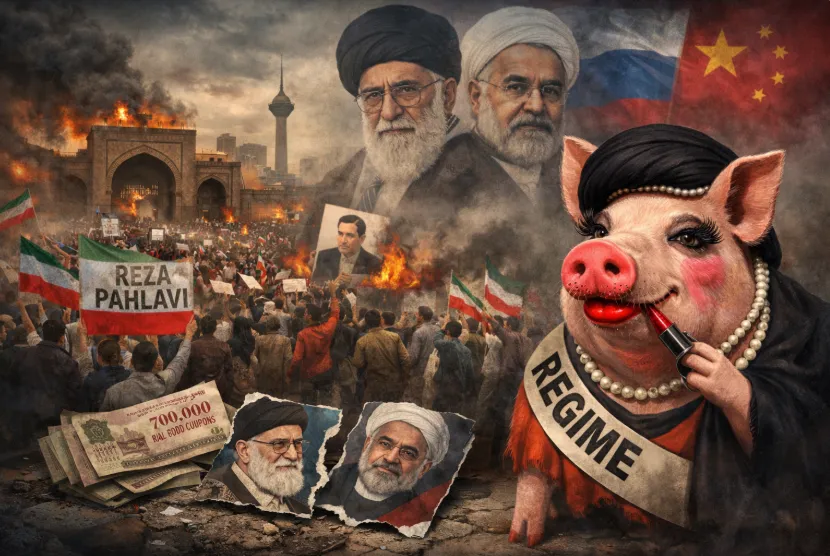
Protests have now entered their tenth consecutive day across Iran. Growing crowds in numerous cities and towns are openly demanding the end of the regime, with many explicitly calling for the return of Reza Pahlavi. This marks a significant departure from previous protest waves, regardless of their size: for the first time, large segments of the population are sending a clear and unmistakable message that they are done with the entire regime.
Despite Ali Khamenei’s attempt to calm the Bazaaris by portraying them as loyal to the Nezam, large sections of the bazaars were shut down today in coordinated strikes. In Tehran, protests expanded in and around the Grand Bazaar, directly contradicting the leadership’s narrative of stability and allegiance among traditional power bases.
Within the camp advocating regime continuity, hardliners appear entirely bankrupt of new ideas. They have fallen back on familiar rhetoric, calling for harsh crackdowns on protesters, whom they dismiss as “rioters,” while once again attacking reformists. The reformist camp, however, is sending more fractured and revealing signals. Some figures, including Javad Zarif and Behzad Nabavi, have rushed to establish a new political party—essentially a cosmetic rebranding, as the old name, or any reference to “reform,” has become an anger trigger and a reminder of years of perceived reformist deceit. Others are openly questioning Khamenei’s health and decision-making capacity, warning that his inability to govern is exacting a severe cost on the country. Notably, some reformist voices are now openly floating the idea of replacing Khamenei with Hassan Rouhani; a remarkable sign of elite-level desperation and fragmentation. On the ground, the protesters’ explicit demand for an end to the regime itself underscores a central reality: continuity through cosmetic change, whether a new figurehead or the reformists’ familiar “lipstick on a pig” approach, is no longer a viable option. The question of succession within the Islamic Republic is deeply contested not only among regime elites but also within the remaining principlist and reformist support bases. Neither Mojtaba Khamenei nor Hassan Rouhani carries decisive weight in this struggle. In practical terms, the system faces a legitimacy vacuum: it is increasingly difficult to identify any successor to Ali Khamenei who could command credibility, authority, or popular acceptance, even among those segments of society that have historically supported the regime.
The Pezeshkian administration, meanwhile, has reverted to the same exhausted economic tactics. It has attempted to placate public anger with food coupons worth roughly seven dollars; a move that not only failed to calm protesters but further enraged them. Many viewed the measure as humiliating, especially when contrasted with reports of substantial monthly payments to Hezbollah fighters. These gestures, along with the rapid spread of false claims about the release of Iran’s frozen assets, echo strategies used by previous administrations and by the newly appointed Central Bank governor, who held the same position under Hassan Rouhani.
There is a growing public understanding that these short-term pacifiers will fuel yet another round of inflation; one the administration appears willing to tolerate given the severity of the protest crisis. This signals that the regime has effectively exhausted its remaining tools of economic management. The government has already announced plans to eliminate the “preferred exchange rate” used for importing essential goods, a move expected to raise prices by 20 to 30 percent. Currency rates and consumer prices have already begun climbing following the appointment of the new Central Bank governor just one week ago.
Another noteworthy development shaping elite discourse inside Iran is the fallout from recent events in Venezuela. Iranian MPs are interpreting the U.S. operation against Venezuela’s president as a coup enabled by internal betrayal, elite defection, and deep infiltration of state institutions. They increasingly frame Venezuela as a cautionary case for Iran, illustrating how economic collapse, weakened legitimacy, and compromised security structures can be exploited by external actors. More significantly, the muted response from Russia and China is widely read as evidence of their transactional approach to alliances, raising quiet but serious concerns in Tehran that these partners might offer little more than diplomatic condemnation if a similar crisis were to unfold in Iran.